
Hairline Design in Turkey: How Surgeons Create Natural Front Hairlines

Researching hairline design in Turkey often starts with one concern: “Will it look natural up close and in photos?” That is a valid question because the front hairline is the most visible part of a hair transplant. A natural outcome depends less on graft count alone and more on surgeon-led planning, facial proportions, and precise graft placement. This guide explains how specialists typically approach natural hairline design Turkey planning, what you can expect from consultation to recovery, and which design details help avoid an artificial “straight line” look. Turkey Cares supports international patients by helping them understand the clinical planning process and coordinating a structured evaluation in Turkey.
What Hairline Design Is and Who It Is For
Hairline design is the strategic planning of where the new front hairline will sit and how it will transition into density behind it. In a front hairline design Turkey plan, surgeons aim to create an age-appropriate hairline that matches facial proportions and natural growth patterns. It is commonly requested for temple recession, hairline recession, and cases where the frontal frame of the face needs rebuilding.
This planning is relevant for both men and women, although the design principles can differ. Men often need a mature hairline that accounts for future loss patterns, while women often need a softer shape with attention to temporal points and overall symmetry. The best approach is always individualized and confirmed after a professional assessment.
How Does the Process Work?
Patients considering a hair transplant hairline design Turkey plan usually want a clear timeline and a realistic idea of what happens at each step.
Initial evaluation
You share photos, hair loss history, and prior treatments if relevant. The clinic evaluates the degree of recession, whether thinning is diffuse, and how stable the hair loss pattern appears. This step also includes a preliminary look at donor capacity because donor supply limits how dense the hairline can be.
Surgeon consultation
The surgeon discusses facial proportions, forehead height, and the desired hairline shape. This is where age-appropriate positioning is planned and where masculine vs feminine hairline characteristics are considered. The goal is a result that looks believable over time, not simply a low hairline.
Procedure and design phase
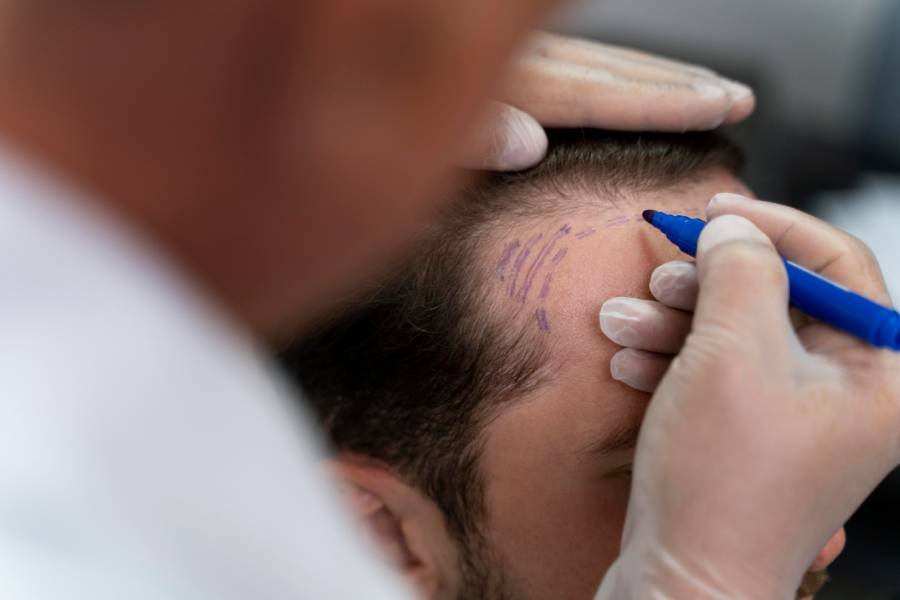
The surgeon maps the hairline, temple points, and the transition zone behind the hairline. A natural plan usually places single-hair grafts at the very front with multi-hair grafts behind for depth and density. Implantation angle and direction are planned to match natural hair growth so the hairline does not look “upright” or pluggy.
Recovery period
Early swelling in the forehead can occur and temporary shedding is expected in many cases. The hairline often looks different at different stages because growth is gradual and density matures over months. Your clinic should explain a realistic timeline for when the front hairline typically starts to look natural.
Follow-up and aftercare
Follow-up focuses on healing, scab management, and early growth monitoring. International patients usually benefit from a clear plan for remote follow-up after returning home and guidance on when to contact the clinic if something looks unusual.
What Makes a Hairline Look Natural?
A natural hairline design in Turkey typically follows several technical and aesthetic principles. These details are often what separate a “transplanted” look from a believable hairline.
Before listing them, it helps to remember that the hairline is not a single line. It is a graded zone with variation, softness, and direction changes.
Micro-irregularities and asymmetry: Natural hairlines are not perfectly straight or perfectly symmetric. Small irregularities help avoid a drawn-on look.
Feathered transition zone: A soft transition created with single-hair grafts prevents a harsh edge.
Correct angles and direction: Front hairline grafts must be placed with shallow angles that mimic natural growth. Poor angulation can create an unnatural “standing up” effect.
Density planning by zone: The hairline rarely needs the same density as mid-scalp. Surgeons balance coverage and density to protect donor supply and avoid an overly dense “doll hair” look.
Temple and temporal point strategy: Temple work can make or break realism because it affects facial framing and side profile aesthetics.
Density, Coverage, and Donor Limits
Many patients focus on graft numbers, but surgeon-led planning often focuses on density distribution and donor safety. The hairline is typically planned with higher visual precision while the area behind it is layered to create the perception of fullness. This is why the same graft count can look very different depending on design quality and hair characteristics such as caliber and curl.
Donor area capacity is a limiting factor. Overharvesting can lead to visible thinning in the donor region, which can be difficult to correct later. A realistic natural hairline design Turkey plan usually prioritizes long-term donor management, especially if future hair loss is expected.
Benefits and Realistic Expectations
A well-designed hairline can improve facial framing and make overall thinning less noticeable. Patients often value the confidence that comes from a natural-looking front hairline in direct light and in close-up photos. Still, individual results vary based on donor quality, hair characteristics, healing patterns, and long-term hair loss progression.
It is also realistic to expect a timeline. Early appearance can be uneven due to shedding and gradual regrowth, and the hairline typically looks more natural as the new hairs mature over months. A professional evaluation is the best way to align goals with what is achievable safely.
Advantages of Hairline Design in Turkey
International patients often choose hairline design in Turkey because treatment can be organized into a clear travel schedule with consultation, procedure, and early follow-ups planned efficiently. A structured process can be especially helpful when planning from abroad, where clear communication and documentation reduce uncertainty.
Turkey Cares supports patients by coordinating surgeon consultations, aligning expectations around design principles, and organizing a well-managed medical travel experience. The focus is on reliability, planning quality, and a professional coordination process rather than unrealistic promises.
You can find information about check-up appointments and current guidelines by reviewing the Turkey Cares Blog. For a personalized, plan-focused initial consultation, you can contact us through the Turkey Cares Contact page.

 CALL US
 WHATSAPP